

The final analysis with 3 years follow-up of the secondary endpoints of the IMpassion031 trial, recently published on Nature Medicine, confirms clinical benefits for peri-operative atezolizumab added to chemotherapy in early-stage triple-negative breast cancer, showing positive effects on circulating tumor (ct)DNA too.
The IMpassion031 trial evaluated atezolizumab added to a standard neoadjuvant chemotherapy regimen and continued after surgery in patients with early-stage triple-negative breast cancer; at the primary analysis, the pathologic complete response rate was significantly improved (58% with atezolizumab plus chemotherapy versus 41% with placebo plus chemotherapy). In the new paper, authors report the final analysis of the secondary endpoints: event-free survival, disease-free survival, overall survival as well as patient reported outcomes and safety 3 years after enrollment of the last patient. Long-term outcomes favored the atezolizumab group, with an event-free survival and disease-free survival hazard ratio of 0.76, and an overall survival hazard ratio of 0.56. Authors also report exploratory longitudinal analyses assessing the potential prognostic and predictive effects of baseline and on-treatment ctDNA levels: results showed that patients with baseline ctDNA-negative status (6%) had excellent long-term outcomes and also that most patients (87%) had cleared ctDNA at surgery, whereas ctDNA-positive status at surgery identified a subset of non-pathologic complete response patients with poorest prognosis. As authors conclude, «some of the exploratory findings from the IMpassion031 dataset are most insightful for future clinical practice, providing unique information on ctDNA evolution during neoadjuvant chemotherapy with or without immune checkpoint blockade. The rarity of ctDNA-negative status at baseline and the associated excellent outcomes, even in the absence of a complete pathological response, is important for patient selection for de-escalation trials. Conversely, high baseline ctDNA that persists despite treatment is associated with the worst outcomes and represents a high unmet need. A challenge for future research is to define and implement adaptive treatment strategies driven not only by tumor response but also by dynamic ctDNA monitoring».
The final analysis with 3 years follow-up of the secondary endpoints of the IMpassion031 trial, recently published on Nature Medicine, confirms clinical benefits for peri-operative atezolizumab added to chemotherapy in early-stage triple-negative breast cancer, showing positive effects on circulating tumor (ct)DNA too.
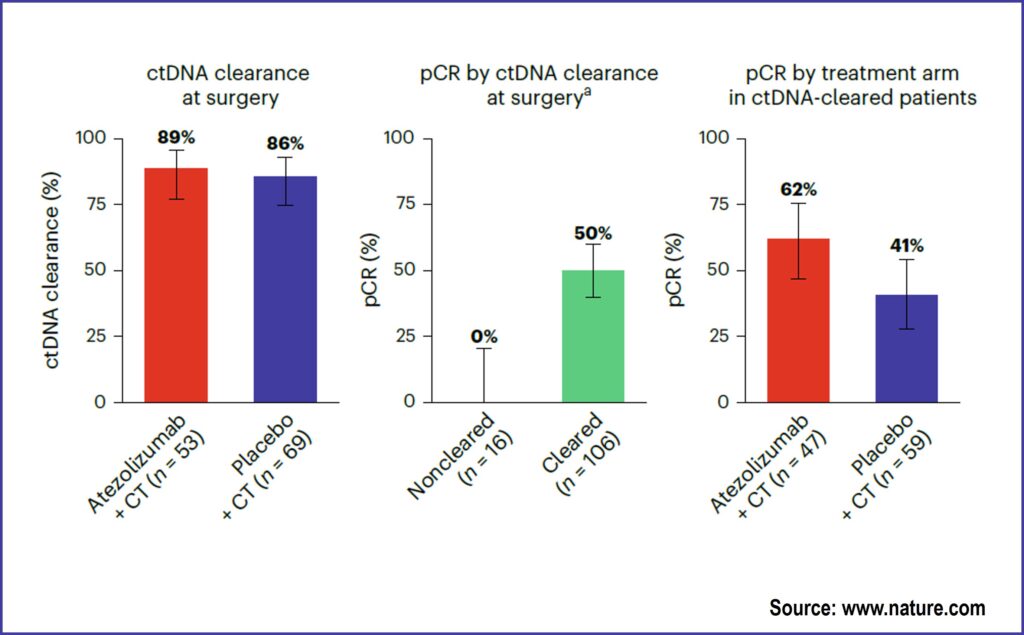
The IMpassion031 trial evaluated atezolizumab added to a standard neoadjuvant chemotherapy regimen and continued after surgery in patients with early-stage triple-negative breast cancer; at the primary analysis, the pathologic complete response rate was significantly improved (58% with atezolizumab plus chemotherapy versus 41% with placebo plus chemotherapy). In the new paper, authors report the final analysis of the secondary endpoints: event-free survival, disease-free survival, overall survival as well as patient reported outcomes and safety 3 years after enrollment of the last patient. Long-term outcomes favored the atezolizumab group, with an event-free survival and disease-free survival hazard ratio of 0.76, and an overall survival hazard ratio of 0.56. Authors also report exploratory longitudinal analyses assessing the potential prognostic and predictive effects of baseline and on-treatment ctDNA levels: results showed that patients with baseline ctDNA-negative status (6%) had excellent long-term outcomes and also that most patients (87%) had cleared ctDNA at surgery, whereas ctDNA-positive status at surgery identified a subset of non-pathologic complete response patients with poorest prognosis. As authors conclude, «some of the exploratory findings from the IMpassion031 dataset are most insightful for future clinical practice, providing unique information on ctDNA evolution during neoadjuvant chemotherapy with or without immune checkpoint blockade. The rarity of ctDNA-negative status at baseline and the associated excellent outcomes, even in the absence of a complete pathological response, is important for patient selection for de-escalation trials. Conversely, high baseline ctDNA that persists despite treatment is associated with the worst outcomes and represents a high unmet need. A challenge for future research is to define and implement adaptive treatment strategies driven not only by tumor response but also by dynamic ctDNA monitoring».