

Results from the phase II SOLTI-1303-PATRICIA trial, recently published on ESMO Open (https://www.sciencedirect.com/science/article/pii/S2059702925014413?ref=pdf_download&fr=RR-2&rr=988d6d343993edd8), show the overall survival data for palbociclib and trastuzumab in HER2+ breast cancer patients, highlighting the relevance of gene expression profiling and biomarker-driven patient selection.
SOLTI-1303-PATRICIA trial is a phase II study investigating palbociclib and trastuzumab, with or without endocrine therapy, in 71 HER2+ metastatic breast cancer patients; cohort A included ER- patients, treated with palbociclib and trastuzumab; cohort B included ER+ patients randomized to receive palbociclib and trastuzumab with (B1) or without (B2) letrozole. Median overall survival was 29.8 months; 4-years survival rates were 13.3% (A cohort), 35.7% (B1 cohort), and 32.3% (B2 cohort). Luminal subtypes had a better overall survival than non-luminal subtypes (38 versus 26.6 months); exploratory analysis of biomarkers showed that luminal-related genes were associated with better long-term survival, while basal and proliferation-related genes were linked to resistance. As authors conclude, «PATRICIA trial validates the efficacy of combining palbociclib with trastuzumab and endocrine therapy in this challenging patient population. Future research should focus on refining biomarker-driven strategies and exploring the integration of novel agents with CDK4/6 inhibitors to further improve outcomes for HR+/HER2+ metastatic breast cancer».
Results from the phase II SOLTI-1303-PATRICIA trial, recently published on ESMO Open (https://www.sciencedirect.com/science/article/pii/S2059702925014413?ref=pdf_download&fr=RR-2&rr=988d6d343993edd8), show the overall survival data for palbociclib and trastuzumab in HER2+ breast cancer patients, highlighting the relevance of gene expression profiling and biomarker-driven patient selection.
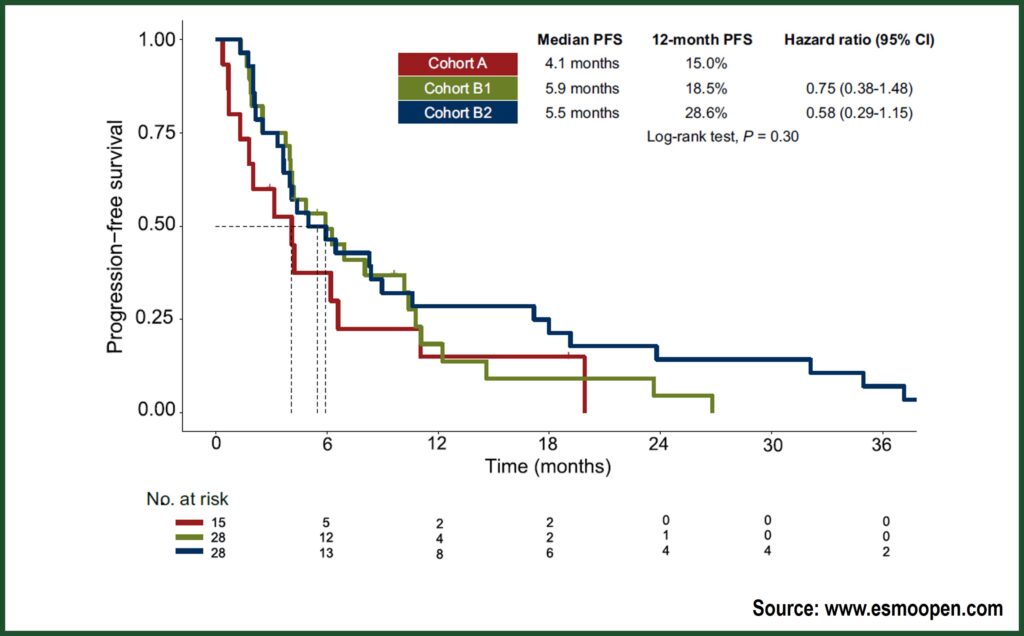
SOLTI-1303-PATRICIA trial is a phase II study investigating palbociclib and trastuzumab, with or without endocrine therapy, in 71 HER2+ metastatic breast cancer patients; cohort A included ER- patients, treated with palbociclib and trastuzumab; cohort B included ER+ patients randomized to receive palbociclib and trastuzumab with (B1) or without (B2) letrozole. Median overall survival was 29.8 months; 4-years survival rates were 13.3% (A cohort), 35.7% (B1 cohort), and 32.3% (B2 cohort). Luminal subtypes had a better overall survival than non-luminal subtypes (38 versus 26.6 months); exploratory analysis of biomarkers showed that luminal-related genes were associated with better long-term survival, while basal and proliferation-related genes were linked to resistance. As authors conclude, «PATRICIA trial validates the efficacy of combining palbociclib with trastuzumab and endocrine therapy in this challenging patient population. Future research should focus on refining biomarker-driven strategies and exploring the integration of novel agents with CDK4/6 inhibitors to further improve outcomes for HR+/HER2+ metastatic breast cancer».