

Overall survival data of the monarchE trial, recently published on Annals of Oncology, showed a clinically meaningful improvement with adjuvant abemaciclib added to endocrine therapy in patients with HR+/HER2- high risk early breast cancer.
In the phase 3 monarchE trial 5637 patients with HR+/HER2- node-positive high risk early breast cancer were randomized to receive endocrine therapy for 5 years with or without abemaciclib for a 2-year treatment period. At a median 6.3 years follow-up, abemaciclib plus endocrine therapy resulted in a 15.8% lower risk of death than endocrine therapy alone. Fewer patients of abemaciclib-endocrine therapy arm were living with metastatic disease and there were improvements both in invasive disease-free survival and distant relapse-free survival: 7-years invasive disease-free survival was 77,4% with abemaciclib-endocrine therapy and 70,9% with endocrine therapy, 7-years distant relapse-free survival were 80.0% and 74.9% respectively. As authors point out, «At 7 years, abemaciclib-endocrine therapy continued to demonstrate a sustained invasive disease-free survival and distant relapse-free survival benefit. The survival benefit, together with the substantial reduction in the risk of metastatic disease, represents a favorable efficacy outcome that should be weighed against the short-term known safety profile of 2 years of abemaciclib therapy. Abemaciclib is the first CDK4/6 inhibitor to demonstrate the translation of the reduction in the risk of recurrence into a significantly improved overall survival».
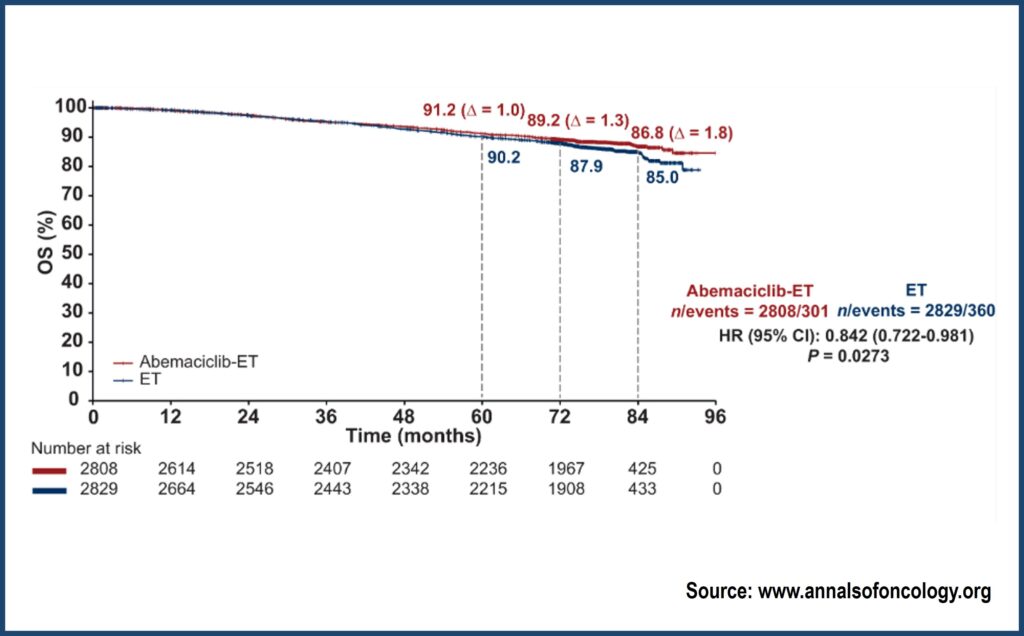
Overall survival data of the monarchE trial, recently published on Annals of Oncology, showed a clinically meaningful improvement with adjuvant abemaciclib added to endocrine therapy in patients with HR+/HER2- high risk early breast cancer.
In the phase 3 monarchE trial 5637 patients with HR+/HER2- node-positive high risk early breast cancer were randomized to receive endocrine therapy for 5 years with or without abemaciclib for a 2-year treatment period. At a median 6.3 years follow-up, abemaciclib plus endocrine therapy resulted in a 15.8% lower risk of death than endocrine therapy alone. Fewer patients of abemaciclib-endocrine therapy arm were living with metastatic disease and there were improvements both in invasive disease-free survival and distant relapse-free survival: 7-years invasive disease-free survival was 77,4% with abemaciclib-endocrine therapy and 70,9% with endocrine therapy, 7-years distant relapse-free survival were 80.0% and 74.9% respectively. As authors point out, «At 7 years, abemaciclib-endocrine therapy continued to demonstrate a sustained invasive disease-free survival and distant relapse-free survival benefit. The survival benefit, together with the substantial reduction in the risk of metastatic disease, represents a favorable efficacy outcome that should be weighed against the short-term known safety profile of 2 years of abemaciclib therapy. Abemaciclib is the first CDK4/6 inhibitor to demonstrate the translation of the reduction in the risk of recurrence into a significantly improved overall survival».