

A new study recently published on Annals of Oncology shows that an ultrasensitive, whole genome sequencing (WGS)-based, tumour-informed ctDNA platform can be used in early breast cancer patients as a strategy to identify patients at high risk of relapse.
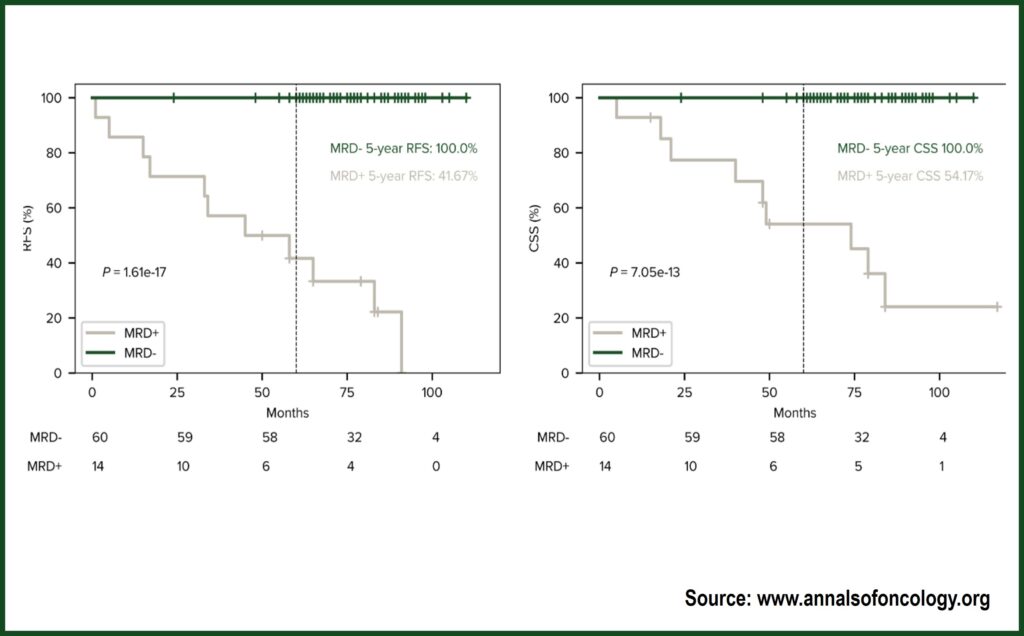
Authors analyzed 617 plasma samples from 78 patients collected at diagnosis before therapy, cycle 2 of neoadjuvant chemotherapy, post-surgery after neoadjuvant therapy if administered, every 3 months during the first year, and every 6 months thereafter. Plasma DNA was analyzed using a tumor-informed WGS approach to produce personalized ctDNA sequencing panels tracking a median of 1451 variants per patient; then, molecular residual disease (MRD) detection was correlated with clinical outcomes. At a median follow-up of 76 months, detection of ctDNA was associated with high risk of future relapse and shortened overall survival, with a median lead time from ctDNA detection to clinical relapse of 15 months. MRD was identified in 100% of patients who relapsed, no ctDNA-undetected patients relapsed throughout follow-up. As authors note, «Early detection of recurrence in early-stage breast cancer patients shows promise for improving patient survival outcomes. Here we show that tracking up to ∼1800 somatic variants for the detection of MRD in plasma ctDNA, both before and after curative-intent treatment, improves the sensitivity of ctDNA detection at diagnosis compared with other MRD methods, and improved lead times for ctDNA detection often years ahead of clinical recurrence based on imaging. Moreover, residual disease immediately after neoadjuvant chemotherapy and surgery can be detected with an ultrasensitive approach, with subsequent adjuvant therapy clearing the low-level residual disease. These findings merit additional investigation through additional prospective studies that can further establish the clinical impact and utility of ultrasensitive MRD approaches in breast cancer», authors conclude.
A new study recently published on Annals of Oncology shows that an ultrasensitive, whole genome sequencing (WGS)-based, tumour-informed ctDNA platform can be used in early breast cancer patients as a strategy to identify patients at high risk of relapse.
Authors analyzed 617 plasma samples from 78 patients collected at diagnosis before therapy, cycle 2 of neoadjuvant chemotherapy, post-surgery after neoadjuvant therapy if administered, every 3 months during the first year, and every 6 months thereafter. Plasma DNA was analyzed using a tumor-informed WGS approach to produce personalized ctDNA sequencing panels tracking a median of 1451 variants per patient; then, molecular residual disease (MRD) detection was correlated with clinical outcomes. At a median follow-up of 76 months, detection of ctDNA was associated with high risk of future relapse and shortened overall survival, with a median lead time from ctDNA detection to clinical relapse of 15 months. MRD was identified in 100% of patients who relapsed, no ctDNA-undetected patients relapsed throughout follow-up. As authors note, «Early detection of recurrence in early-stage breast cancer patients shows promise for improving patient survival outcomes. Here we show that tracking up to ∼1800 somatic variants for the detection of MRD in plasma ctDNA, both before and after curative-intent treatment, improves the sensitivity of ctDNA detection at diagnosis compared with other MRD methods, and improved lead times for ctDNA detection often years ahead of clinical recurrence based on imaging. Moreover, residual disease immediately after neoadjuvant chemotherapy and surgery can be detected with an ultrasensitive approach, with subsequent adjuvant therapy clearing the low-level residual disease. These findings merit additional investigation through additional prospective studies that can further establish the clinical impact and utility of ultrasensitive MRD approaches in breast cancer», authors conclude.