

In a new study recently published on npj Breast Cancer, Fondazione Michelangelo’s researchers, in collaboration with Vanderbilt University Medical Center in Nashville and the University of Cambridge, performed a biomarker analysis of the phase III NeoTRIP trial and showed that tumor-specific MHC-II (tsMHC-II) expression can predict the response to atezolizumab combined to chemotherapy in early stage triple negative breast cancer.
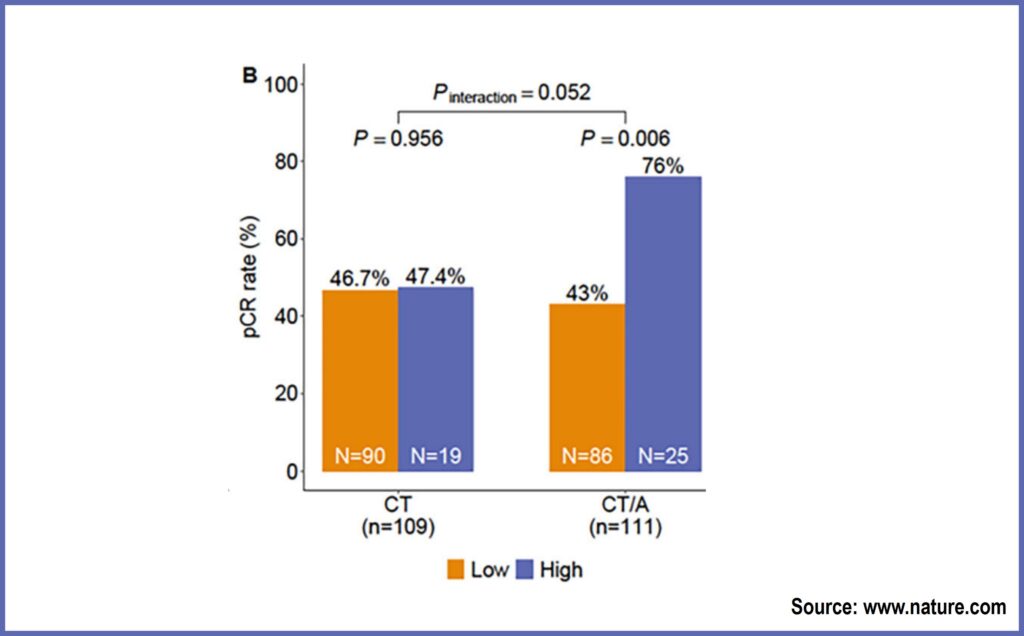
As authors point out, biomarkers that can identify patients that could benefit from the addition of immune checkpoint therapy to neoadjuvant chemotherapy are needed and tsMHC-II has been identified as a potential biomarker for PD-1/PD-L1 targeted immunotherapy in other cancer types. Thus, researchers used imaging mass cytometry to assess tsMHC-II expression in tumor samples collected from participants of the phase III NeoTRIP trial, where patients with early stage triple negative breast cancer were randomized to neoadjuvant carboplatin and nab-paclitaxel with or without atezolizumab. Results show that tsMHC-II positivity was associated with a higher pathological complete response rate in the atezolizumab arm, but not in the chemotherapy-only arm. TsMHC-II demonstrated clinical validity as predictive biomarker of immunotherapy benefit in this setting and as authors conclude «We are continuing to work on harmonizing tsMHC-II assays to define the most practical approach that can be prospectively validated in a pre-planned and defined fashion to demonstrate true clinical utility, with careful consideration of establishing the most widely-available assay that can be performed in the most technically rigorous way».
As authors point out, biomarkers that can identify patients that could benefit from the addition of immune checkpoint therapy to neoadjuvant chemotherapy are needed and tsMHC-II has been identified as a potential biomarker for PD-1/PD-L1 targeted immunotherapy in other cancer types. Thus, researchers used imaging mass cytometry to assess tsMHC-II expression in tumor samples collected from participants of the phase III NeoTRIP trial, where patients with early stage triple negative breast cancer were randomized to neoadjuvant carboplatin and nab-paclitaxel with or without atezolizumab. Results show that tsMHC-II positivity was associated with a higher pathological complete response rate in the atezolizumab arm, but not in the chemotherapy-only arm. TsMHC-II demonstrated clinical validity as predictive biomarker of immunotherapy benefit in this setting and as authors conclude «We are continuing to work on harmonizing tsMHC-II assays to define the most practical approach that can be prospectively validated in a pre-planned and defined fashion to demonstrate true clinical utility, with careful consideration of establishing the most widely-available assay that can be performed in the most technically rigorous way».