

In a phase 3 trial recently published on The New England Journal of Medicine, the oral proteolysis-targeting chimera (PROTAC) estrogen receptor degrader vepdegestrant showed a significantly longer progression-free survival than fulvestrant in the subgroup with ESR1 mutations but not in the full patient population.
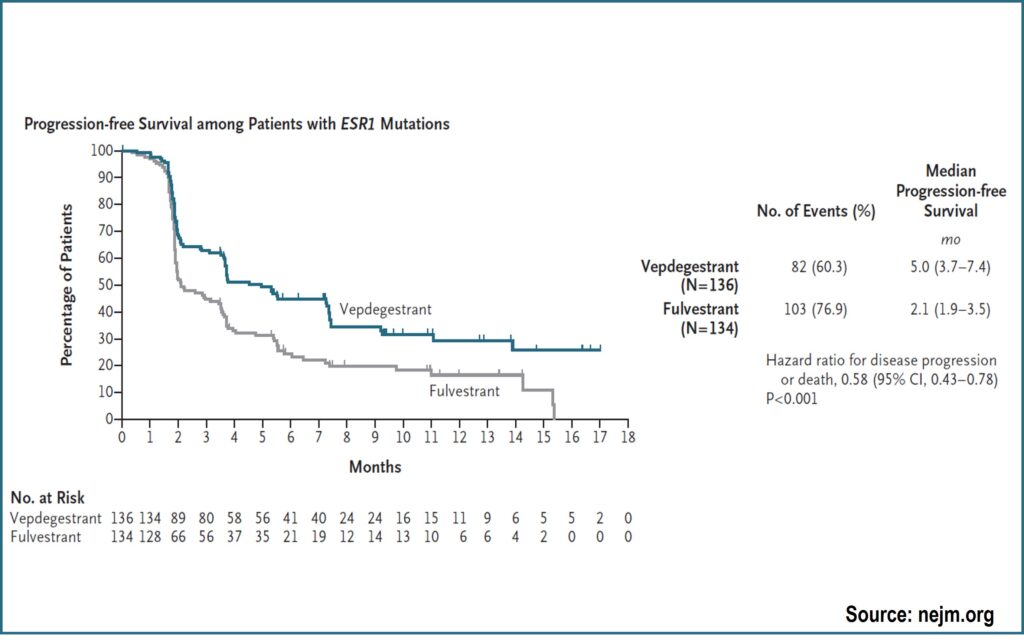
The VERITAC-2 trial enrolled a total of 624 patients with ER-positive, HER2–negative advanced breast cancer who had received one previous line of cyclin-dependent kinase 4 and 6 inhibitor therapy plus one line of endocrine therapy. Patients were randomly assigned to receive vepdegestrant or fulvestrant; in the subgroup with ESR1 mutations, the median progression-free survival was 5 months with vepdegestrant and 2.1 months with fulvestrant, whereas among all patients the median progression-free survival was 3.8 months with vepdegestrant and 3.6 months with fulvestrant. The most common reason for treatment discontinuation was disease progression; the median treatment duration was 4.2 months in the vepdegestrant group and 3.7 months in the fulvestrant group. As authors point out, «These results suggest that endocrine sensitivity is preserved in ESR1-mutated disease, whereas tumors without ESR1 mutations may be driven by multiple alternative pathways, which may limit overall benefit from endocrine monotherapy in the second-line setting. In addition, fulvestrant may have limited activity in patients with ESR1 mutations because of its poor bioavailability. Vepdegestrant had a favorable safety profile with mainly low-grade adverse events and a low incidence of gastrointestinal-related adverse events. The new PROTAC estrogen receptor degrader led to significantly longer progression-free survival than fulvestrant in previously treated patients with ESR1-mutated, ER-positive, HER2-negative advanced breast cancer», authors conclude.
In a phase 3 trial recently published on The New England Journal of Medicine, the oral proteolysis-targeting chimera (PROTAC) estrogen receptor degrader vepdegestrant showed a significantly longer progression-free survival than fulvestrant in the subgroup with ESR1 mutations but not in the full patient population.
The VERITAC-2 trial enrolled a total of 624 patients with ER-positive, HER2–negative advanced breast cancer who had received one previous line of cyclin-dependent kinase 4 and 6 inhibitor therapy plus one line of endocrine therapy. Patients were randomly assigned to receive vepdegestrant or fulvestrant; in the subgroup with ESR1 mutations, the median progression-free survival was 5 months with vepdegestrant and 2.1 months with fulvestrant, whereas among all patients the median progression-free survival was 3.8 months with vepdegestrant and 3.6 months with fulvestrant. The most common reason for treatment discontinuation was disease progression; the median treatment duration was 4.2 months in the vepdegestrant group and 3.7 months in the fulvestrant group. As authors point out, «These results suggest that endocrine sensitivity is preserved in ESR1-mutated disease, whereas tumors without ESR1 mutations may be driven by multiple alternative pathways, which may limit overall benefit from endocrine monotherapy in the second-line setting. In addition, fulvestrant may have limited activity in patients with ESR1 mutations because of its poor bioavailability. Vepdegestrant had a favorable safety profile with mainly low-grade adverse events and a low incidence of gastrointestinal-related adverse events. The new PROTAC estrogen receptor degrader led to significantly longer progression-free survival than fulvestrant in previously treated patients with ESR1-mutated, ER-positive, HER2-negative advanced breast cancer», authors conclude.