

HR+/HER2+ breast cancer: FDA approves a chemotherapy-free maintenance treatment. A journey from biology to therapy
A research line long pursued by Fondazione Michelangelo led to FDA approval of palbociclib in combination with trastuzumab, with or without pertuzumab, and endocrine therapy for HR+/HER2+ locally advanced or metastatic breast cancer
The Food and Drug Administration has recently approved palbociclib in combination with trastuzumab, with or without pertuzumab, and endocrine therapy for adult patients with HR+/HER2+ locally advanced or metastatic breast cancer following induction treatment of a few months that also include chemotherapy. The approval is based on results from the international Phase III trial PATINA, sponsored by the Alliance Foundation Trials LLC, which enrolled 518 patients worldwide.
Such a milestone, offering new therapeutic options for women diagnosed with an aggressive subtype of advanced breast cancer, comes after years of research opened by the NA-PHER2 trial, sponsored by Fondazione Michelangelo, a concrete example of the translation of basic research and biological knowledge into innovative treatment combinations.
NA-PHER2 was a multicenter Italian phase II study aimed to test a triple targeting of ER, HER2 and RB pathways as a chemotherapy-free treatment strategy in women with early HR+/HER2+ breast cancer. Further results of NA-PHER2 trial in two expansion cohorts showed that neoadjuvant therapy with trastuzumab, pertuzumab and palbociclib drastically reduced tumor proliferation in most patients and lead to pathological complete response in more than 20% of them.
Parallel research in pre-clinical models, coordinated by Fondazione Michelangelo, demonstrated that the co-targeting of RB by CDK4/6 inhibition voids the escape mechanisms induced by ER/HER2 cross-talk and triggers the transition from cell quiescence to irreversible senescence.
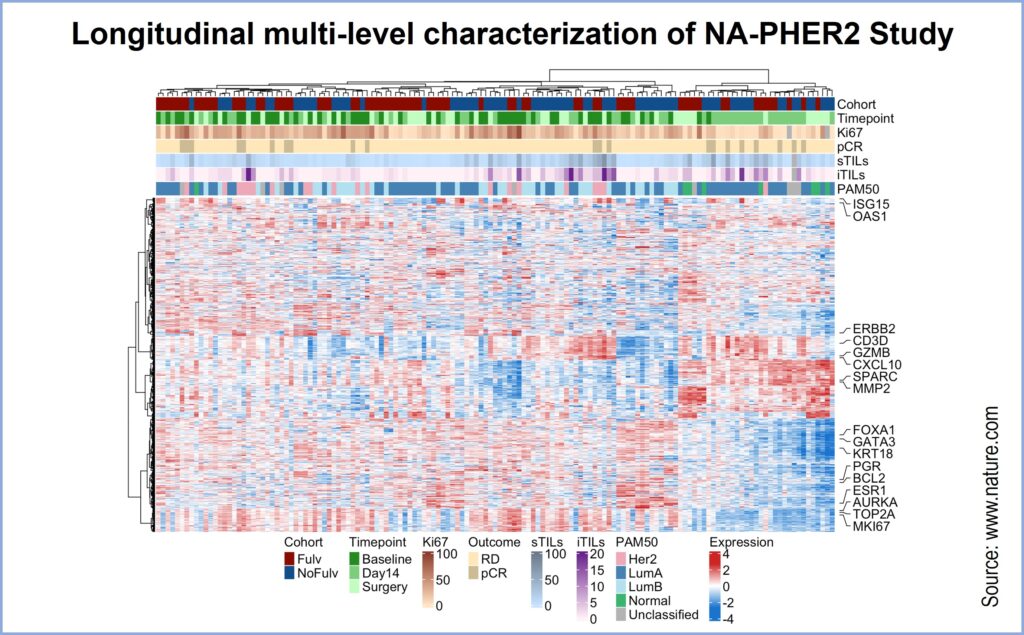
More recently, a translational study of Fondazione published on Nature Communications identified new biomarkers predictive of response by analyzing molecular data from tumor tissues collected during the NA-PHER2 trial.
The PATINA phase III trial, coordinated in Italy by Fondazione Michelangelo, further demonstrated an advantage in progression-free survival of patients by concurrent inhibition of HER2, endocrine receptors and the cell cycle through CDK4/6 inhibition. The addition of palbociclib to standard first-line maintenance therapy significantly prolongs progression-free survival demonstrating a 24% reduction in the risk of progression or death compared with standard therapy alone. The median PFS in the two arms was 44.3 months (CI 32.4–56.8) in the palbociclib treatment group and 29.1 months (CI 23.3–38.6) in the control group. These results led to the FDA approval on 24 June 2026, the culmination of years of collaborative research aimed at improving outcomes for patients with HR+/HER2+ metastatic breast cancer.
Read more on Fondazione Michelangelo website:
HR+/HER2+ breast cancer: FDA approves a chemotherapy-free maintenance treatment. A journey from biology to therapy
A research line long pursued by Fondazione Michelangelo led to FDA approval of palbociclib in combination with trastuzumab, with or without pertuzumab, and endocrine therapy for HR+/HER2+ locally advanced or metastatic breast cancer
The Food and Drug Administration has recently approved palbociclib in combination with trastuzumab, with or without pertuzumab, and endocrine therapy for adult patients with HR+/HER2+ locally advanced or metastatic breast cancer following induction treatment of a few months that also include chemotherapy. The approval is based on results from the international Phase III trial PATINA, sponsored by the Alliance Foundation Trials LLC, which enrolled 518 patients worldwide.
Such a milestone, offering new therapeutic options for women diagnosed with an aggressive subtype of advanced breast cancer, comes after years of research opened by the NA-PHER2 trial, sponsored by Fondazione Michelangelo, a concrete example of the translation of basic research and biological knowledge into innovative treatment combinations.
NA-PHER2 was a multicenter Italian phase II study aimed to test a triple targeting of ER, HER2 and RB pathways as a chemotherapy-free treatment strategy in women with early HR+/HER2+ breast cancer. Further results of NA-PHER2 trial in two expansion cohorts showed that neoadjuvant therapy with trastuzumab, pertuzumab and palbociclib drastically reduced tumor proliferation in most patients and lead to pathological complete response in more than 20% of them.
Parallel research in pre-clinical models, coordinated by Fondazione Michelangelo, demonstrated that the co-targeting of RB by CDK4/6 inhibition voids the escape mechanisms induced by ER/HER2 cross-talk and triggers the transition from cell quiescence to irreversible senescence.
More recently, a translational study of Fondazione published on Nature Communications identified new biomarkers predictive of response by analyzing molecular data from tumor tissues collected during the NA-PHER2 trial.
The PATINA phase III trial, coordinated in Italy by Fondazione Michelangelo, further demonstrated an advantage in progression-free survival of patients by concurrent inhibition of HER2, endocrine receptors and the cell cycle through CDK4/6 inhibition. The addition of palbociclib to standard first-line maintenance therapy significantly prolongs progression-free survival demonstrating a 24% reduction in the risk of progression or death compared with standard therapy alone. The median PFS in the two arms was 44.3 months (CI 32.4–56.8) in the palbociclib treatment group and 29.1 months (CI 23.3–38.6) in the control group. These results led to the FDA approval on 24 June 2026, the culmination of years of collaborative research aimed at improving outcomes for patients with HR+/HER2+ metastatic breast cancer.
Read more on Fondazione Michelangelo website: