

Adding carboplatin to adjuvant epirubicin/cyclophosphamide followed by taxanes in early-stage triple-negative breast cancer
Clinical benefits on disease-free survival and overall survival with the addition of carboplatin to adjuvant epirubicin/cyclophosphamide followed by taxanes in early-stage triple-negative breast cancer
A new paper recently published on The Journal of Clinical Oncology show that the addition of carboplatin to an adjuvant therapy with epirubicin and cyclophosphamide followed by taxanes improves disease-free survival, distant-disease free survival and overall survival in early-stage triple-negative breast cancer.
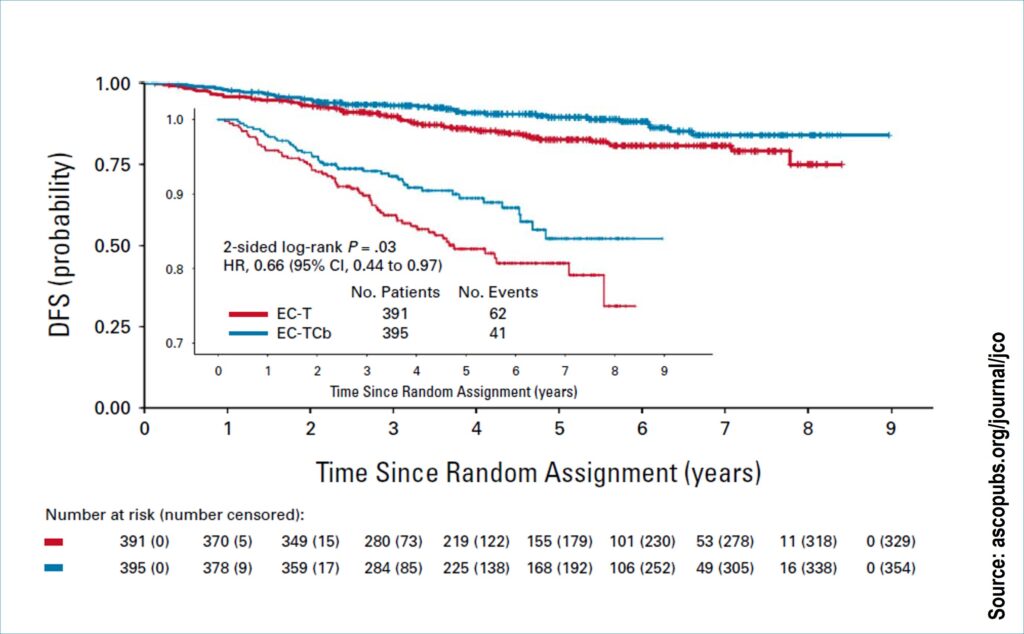
In this phase III trial, a total of 786 patients with triple-negative breast cancer who have received definitive surgery were randomized to receive four cycles of epirubicin/cyclophosphamide followed by four cycles of taxanes with or without carboplatin adjuvant chemotherapy. After a median follow-up of 4.52 years, the addition of carboplatin resulted in a significant improvement of disease-free survival, distant disease-free survival and overall survival; a higher incidence of hematologic adverse events, namely neurotropenia and trombocitopenia, was seen in the carboplatin treated group, but no other safety signals emerged. As authors note, «Several trials found that the addition of carboplatin to standard anthracycline and taxane agents could improve pathologic complete response rate in triple-negative breast cancer. On the basis of these results, carboplatin has been considered for high-risk early-stage triple-negative breast cancer in the neoadjuvant setting, but evidence in adjuvant setting was limited. Our data show that adjuvant carboplatin significantly reduced the recurrence risk of early-stage triple-negative breast cancer, when added to standard anthracycline and taxane-based treatment, supporting adjuvant chemotherapy integrating carboplatin as an effective regimen for triple-negative breast cancer treatment for patients not receiving neoadjuvant treatment».
Adding carboplatin to adjuvant epirubicin/cyclophosphamide followed by taxanes in early-stage triple-negative breast cancer
Clinical benefits on disease-free survival and overall survival with the addition of carboplatin to adjuvant epirubicin/cyclophosphamide followed by taxanes in early-stage triple-negative breast cancer
A new paper recently published on The Journal of Clinical Oncology show that the addition of carboplatin to an adjuvant therapy with epirubicin and cyclophosphamide followed by taxanes improves disease-free survival, distant-disease free survival and overall survival in early-stage triple-negative breast cancer.
In this phase III trial, a total of 786 patients with triple-negative breast cancer who have received definitive surgery were randomized to receive four cycles of epirubicin/cyclophosphamide followed by four cycles of taxanes with or without carboplatin adjuvant chemotherapy. After a median follow-up of 4.52 years, the addition of carboplatin resulted in a significant improvement of disease-free survival, distant disease-free survival and overall survival; a higher incidence of hematologic adverse events, namely neurotropenia and trombocitopenia, was seen in the carboplatin treated group, but no other safety signals emerged. As authors note, «Several trials found that the addition of carboplatin to standard anthracycline and taxane agents could improve pathologic complete response rate in triple-negative breast cancer. On the basis of these results, carboplatin has been considered for high-risk early-stage triple-negative breast cancer in the neoadjuvant setting, but evidence in adjuvant setting was limited. Our data show that adjuvant carboplatin significantly reduced the recurrence risk of early-stage triple-negative breast cancer, when added to standard anthracycline and taxane-based treatment, supporting adjuvant chemotherapy integrating carboplatin as an effective regimen for triple-negative breast cancer treatment for patients not receiving neoadjuvant treatment».