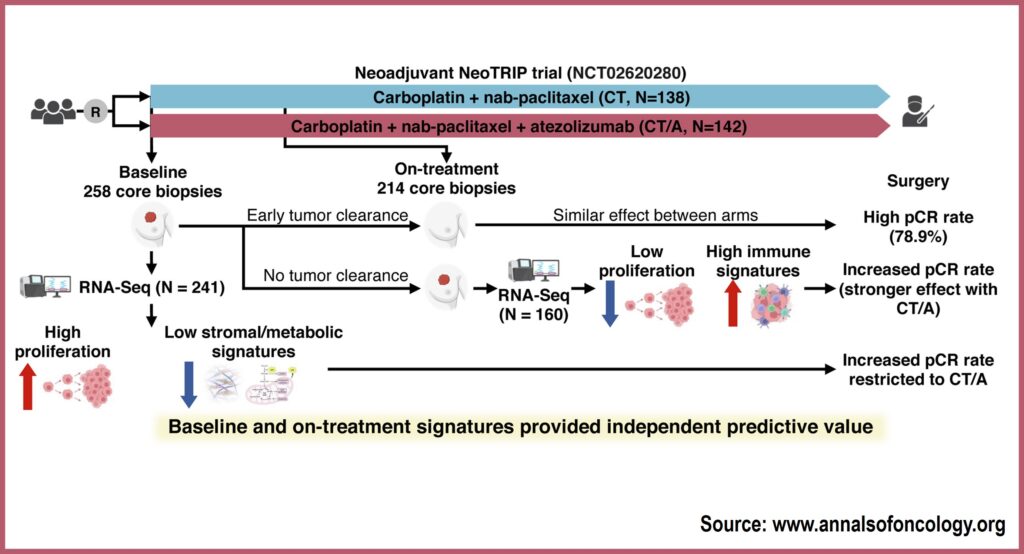

Longitudinal transcriptomic profiling is emerging as a promising tool to identify biomarkers of response to neoadjuvant chemoimmunotherapy in triple-negative breast cancer. This is the key finding of a study published in Annals of Oncology and conducted within the phase III NeoTRIPaPDL1 trial.
Conducted by the Breast Cancer Translational group of Fondazione Michelangelo, coordinated by professor Giampaolo Bianchini, the research analyzed tumor samples collected before treatment initiation and during its early phases. By performing repeated analyses over time in the same patients, researchers were able not only to capture the tumor’s baseline characteristics but also to track its biological evolution during therapy. The results highlight a marked remodeling of the tumor microenvironment, closely associated with clinical outcomes.
In particular, the early absence of tumor cells in biopsies taken during treatment proved to be a strong predictor of pathological complete response. At the same time, activation of immune-related programs during therapy emerged as one of the main factors linked to the effectiveness of chemoimmunotherapy, surpassing the predictive value of certain metabolic signatures observed before treatment initiation.
The study shows that intrinsic tumor features, combined with treatment-induced immune signals, may provide complementary insights to guide clinical decision-making. Overall, the findings support the development of increasingly personalized neoadjuvant strategies based on dynamic biomarkers and early disease evolution.